For the modern enterprise in 2026, the "all-in" cloud approach has evolved. Most organizations now favor a hybrid model, keeping sensitive legacy data on-premise while leveraging the massive scalability of Hetzner Cloud. However, this flexibility introduces a dual challenge: maintaining robust hybrid cloud security while ensuring seamless hybrid cloud management. Bridging the gap between a private data center and a public cloud provider requires more than just a connection it requires a unified orchestration layer that secures your build fleet without ballooning your operational budget.
1. The Complexity of Hybrid Cloud Management
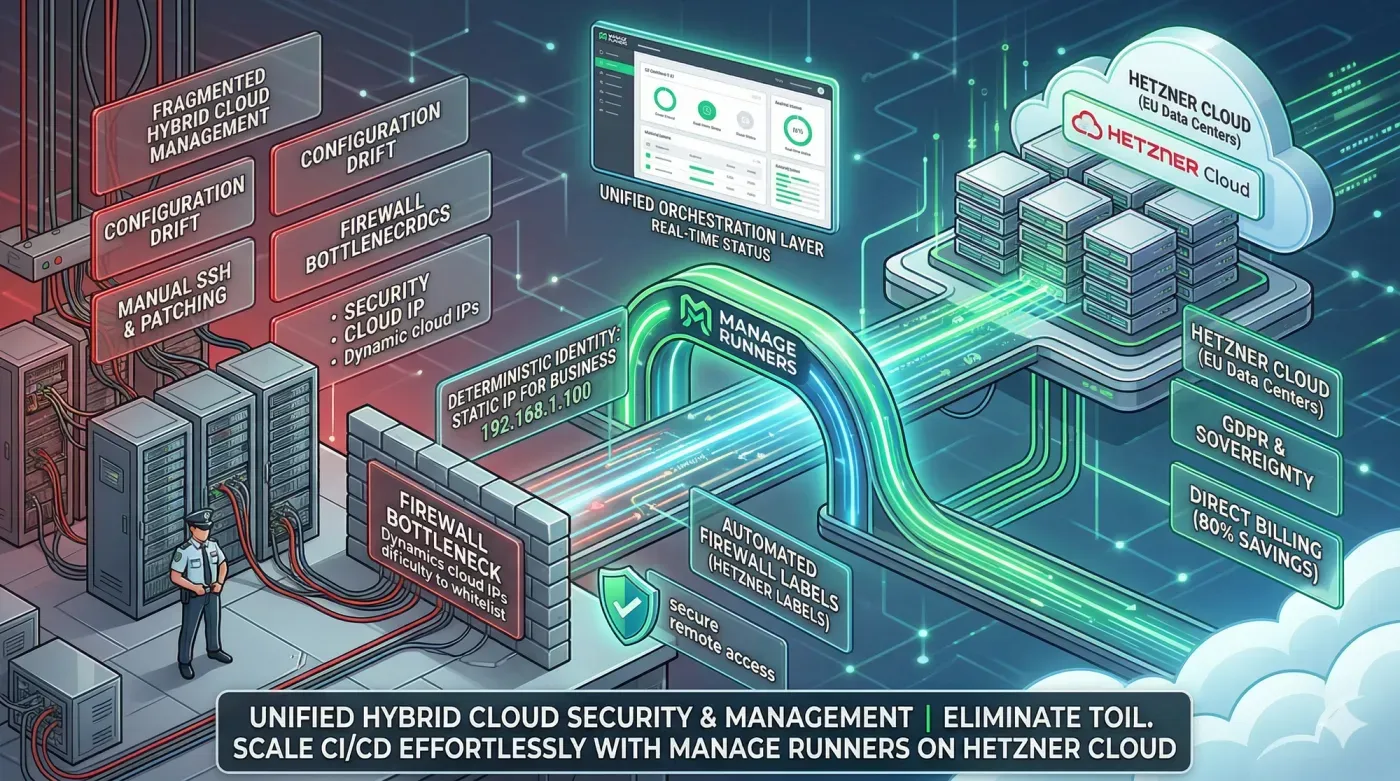
Managing fragmented environments is the primary hurdle for DevOps teams today. When your source code resides on-premise but your CI/CD runners scale in the cloud, you face "configuration drift." Hybrid cloud management involves synchronizing security policies, hardware specifications, and access controls across different infrastructures. Without a centralized control plane, IT departments often find themselves manually patching cloud instances to match on-premise security standards, leading to massive operational "toil."
2. Strategic Pillars of Hybrid Cloud Security
In a hybrid setup, the network perimeter is porous. To maintain hybrid cloud security, teams must move beyond basic password protection and focus on:
- Identity-Based Access: Ensuring only verified cloud instances can talk to your on-premise databases.
- Network Isolation: Using firewalls and labels to prevent lateral movement in the event of a breach.
- Deterministic Connectivity: Moving away from dynamic, unpredictable IP ranges that make firewall whitelisting a nightmare.
3. The Firewall Bottleneck: Dynamic vs. Static Infrastructure
A common failure in hybrid cloud management is the use of dynamic cloud IPs for build runners. If your cloud provider cycles your runner's IP address every time it restarts, you are forced to open wide holes in your on-premise firewall. This significantly weakens your hybrid cloud security. The solution is to ensure every cloud-based runner has a fixed, static identity, allowing your on-premise security team to apply "least-privilege" access rules.
4. Automating the Bridge: Manage Runners on Hetzner
The most efficient way to achieve secure hybrid cloud management is through automated orchestration. Manage Runners is a specialized platform designed to deploy and manage GitLab runners on Hetzner Cloud in under 3 minutes, specifically catering to hybrid security needs.
Key Technical Advantages:
- Static IP for Business: Every runner is assigned a static IP address, making it easy to whitelist cloud resources in your on-premise firewall.
- Automated Security Labels: Automatically assign Hetzner Firewalls to your runners by applying Hetzner Labels through the dashboard.
- GDPR & Sovereignty: Since runners are hosted in your own Hetzner account (based in the EU), your data remains compliant with strict security regulations.
# Example: Restricting On-Premise Deployment to a Secure Cloud Runner IP
deploy_to_on_prem:
  stage: deploy
  tags:
    - hetzner-static-ip-runner
  script:
    - scp -o StrictHostKeyChecking=no ./build.tar.gz admin@onprem-server.local:/apps/
    - # Your on-prem firewall only allows this specific static IP
5. Conclusion: Scaling Without the Security Tax
Mastering hybrid cloud security doesn't have to be a manual burden. By adopting a tool that prioritizes deterministic identity and automated hybrid cloud management, you can bridge the gap between your local data center and Hetzner Cloud with total confidence.
Manage Runners allows you to eliminate the enterprise markup of managed CI services, reclaiming up to 80% of your budget while keeping your build fleet secured behind static IPs and automated firewalls.
Ready to secure your hybrid environment and stop the manual configuration toil? [Start your Hybrid Cloud journey with Manage Runners today] and experience the power of automated, secure CI/CD orchestration.